How to Extract Attachments from EML Files (3 Easy Ways)

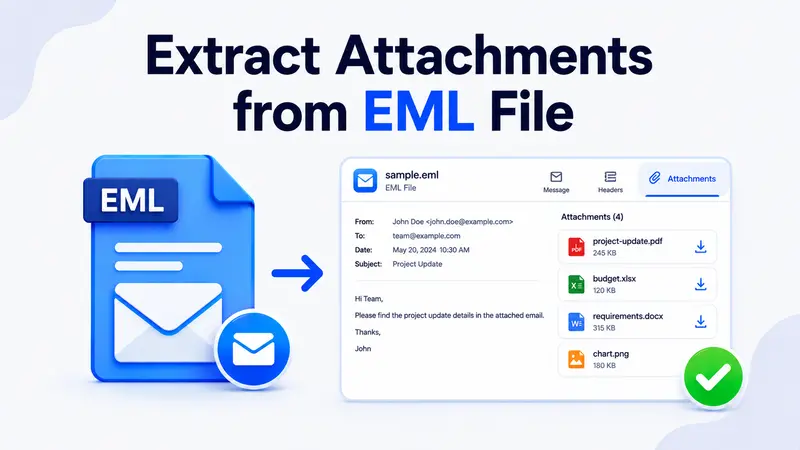
Summary: You can extract attachments from EML files in four ways, by using a free online EML viewer, by running a small Python script, by opening the file in Thunderbird or another desktop client, or by using a dedicated SysTools extractor. So this guide covers each route step-by-step with use cases, tips and the original screenshot intact.
Table of Contents
- Why Users Want to Download EML Attachments
- Best Online Solution to Extract Attachments from EML
- 3-Step Solution to View and Download EML Attachments
- Extract Attachments from EML Files With Python
- Extract Attachments with a Desktop Mail Client
- Expert Tool: SysTools EML Attachment Extractor
- Tips for Handling Large or Encoded Attachments
- Conclusion
- FAQs
EML Viewer Online Tool
View EML files and download every attachment from any browser. No install required.
Emails are one of the most used modes of communication for personal and professional users. So they also carry a lot of important data in the form of attachments. As a result, many users want to back up the data in these attachments for various reasons from their EML files. Therefore, this guide walks through the easy and verified solutions to extract attachments from EML files.
You will find an online route that needs no install, a Python option for developers, a manual Thunderbird method and an expert-grade desktop extractor. Furthermore, every original step sequence and the reference screenshot are preserved exactly as in the source.
Why Users Want to Download EML Attachments
Many users keep a backup of their emails by saving them in the EML format. However, this backup is only for single emails. With the increase in the number of emails and attachments, it becomes difficult to manage them on an individual basis, increasing the chances of data loss. Similarly, there are various other reasons why users want to extract attachments from EML files. So let us have a look at a few of them.
- Saving the attachments from EML files makes it very easy to work with, because they can be opened, shared and edited without any hassle.
- As the number of emails and attachments increases, it becomes difficult to manage them efficiently. Therefore, it is better to download EML attachments to your local system.
- In case you have renamed or made any changes to the saved attachments, then the original files remain intact and you can save them again from the EML files whenever necessary.
- Forensic and legal teams need to extract attachments separately so the body and the files can be reviewed under different chain-of-custody rules.
- Bulk archivists prefer extracted attachments because PDFs, DOCX and images compress and search better when stored outside the .eml wrapper.
Best Online Solution to Extract Attachments from EML Files
We have discussed how important it is to extract and save the attachments inside the EML files for convenient access. So how can it be done? The best solution for this is to use the Online EML Viewer, a free online service that allows users to access all the information inside the EML files with all data attributes and other information.
There are multiple reasons why you should consider using this online solution. So let us have a look at a few of them.
- There is no installation required, because it allows you to access the EML files with all attachments directly from the web browser.
- With the help of its user-friendly interface, users can view and download EML attachments included in the uploaded files with all metadata, such as time stamps, recipient and sender details.
- As it is a browser-based solution, it works as a universal solution and can be used on any device and all operating systems, including Mac, Windows, Linux and Ubuntu.
- Users can open and view their EML files instantly without the requirement of any downloads or installation, just by dragging or dropping the files from your system storage.
3-Step Solution to View and Download EML Attachments
- Click on Drag and Drop Files here to select the EML files on your system storage.
- In the next step, click on the Preview Message option to proceed and scroll down to view your EML messages.
- Click on a particular message to view and download the attachments inside.
Furthermore, the viewer keeps the original headers visible while you preview, so you can confirm the sender and timestamps before saving any attachment to disk.
Extract Attachments from EML Files With Python
If you are technical and have good coding knowledge, then you can use Python to extract attachments from EML files. So this solution is more involved and users sometimes experience several errors. Therefore, this route is not suggested for everyone. However, if you are still interested in Python, learn about the tactic first, because most users get stuck in the middle and run into problems due to bugs. Furthermore, if you still want to proceed with the Python framework, first learn about Stack Overflow and download the necessary resources to save EML attachments using Python.
At a high level the script uses the built-in email module to parse the .eml, walks through each MIME part with msg.walk(), checks part.get_content_disposition() for the value attachment, then writes the decoded payload to disk using part.get_filename(). So that single loop covers the majority of well-formed EML files. However, malformed or quoted-printable parts often need extra handling, which is where most beginners get stuck.
Extract Attachments from EML With a Desktop Mail Application
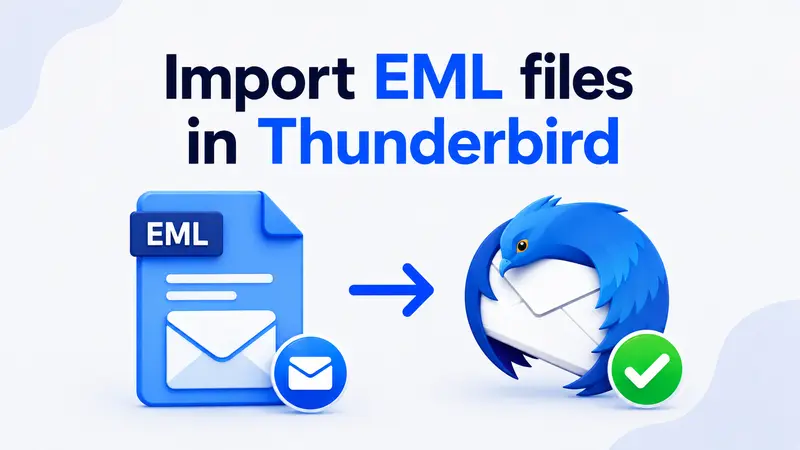
This manual method to extract EML attachments uses a desktop email application. So users need to launch the Thunderbird desktop application beforehand. For a full walkthrough, see our guide to import EML files in Thunderbird. Once you download and install the desktop email app, follow the steps mentioned below.
- Run Thunderbird on your PC.
- After that, generate a new folder and drag and drop EML files into it.
- Then, open the email message to save attachments.
- Now, hit on the attachment icon, below the message.
- Finally, browse the location and hit save to extract attachments from EML.
Thunderbird preserves the original filename and MIME type for each attachment. So the saved files open in their native apps without any extra conversion. Furthermore, the app handles multipart and nested messages cleanly, which is helpful for forwarded chains.
Expert Tool: SysTools EML Attachment Extractor
This is the expert-suggested solution, the SysTools EML Attachment Extractor Software. So this software can extract EML or EMLX files from multiple files and folders and save them to the local drive. As a result, users with thousands of .eml files can run a single batch rather than opening each message by hand.

The tool supports advanced filters for file type, size and date, so you can extract only the PDFs or only the images received in a given month. Moreover, the destination panel lets you choose a custom folder, maintain folder hierarchy and skip duplicates during the extraction run.
SysTools EML Attachment Extractor
Batch-extract attachments from thousands of EML and EMLX files with smart filters. Users can try it for themselves.
For related help on opening .eml files when Outlook fails, see our guide on EML file not opening in Outlook.
Tips for Handling Large or Encoded Attachments
Even with the right tool, certain EML files refuse to give up their attachments cleanly. So here are quick tips that cover the most common edge cases.
- Base64 blocks attachments are stored inline as base64. As a result, the .eml grows large. So use a desktop client or extractor rather than a browser tab for files over 25 MB.
- Nested forwards a forwarded email keeps the original attachments inside a message/rfc822 part. Therefore, walk every nested part during extraction rather than only the top level.
- Encrypted content S/MIME or PGP attachments need the matching key. So decrypt first in the email client, then export the plain attachments.
- Filename collisions when many emails share the same attachment name, prefix the output with the message date or subject to avoid overwrites.
- Charset issues non-UTF-8 filenames sometimes save as gibberish. So pick a tool that respects RFC 2231 encoded filenames.
Conclusion
Through this article, we have discussed online as well as professional solutions for users who want to extract attachments from EML files online. So both have their benefits and users can pick any of them as per their requirements. However, the online solution can be a better option for users who want instant access to their EML files with an option to view and download attachments on all operating systems and devices.
For a single file or a quick preview, the free online viewer is fastest. For thousands of .eml files with filters, the SysTools extractor is the cleanest. So pick the route that matches your file count and your privacy requirements.
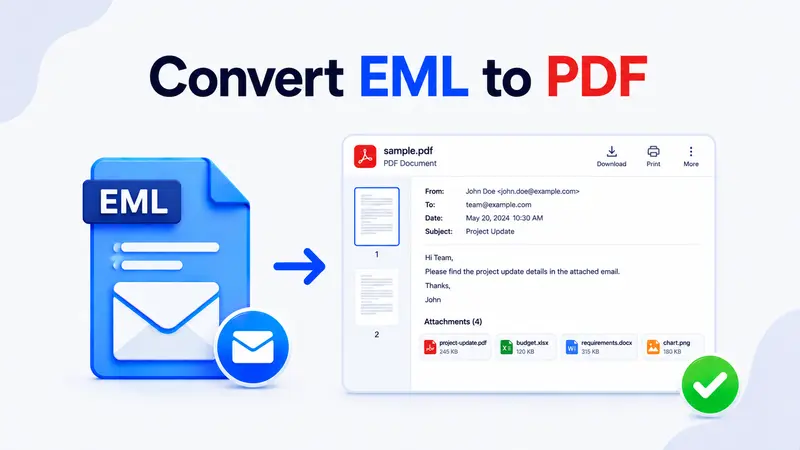
Looking to keep the message body together with its attachments inside one document instead of saving attachments separately? Then follow our convert EML to PDF guide to embed every attachment inside the final PDF.
Frequently Asked Questions
Q1. Can I extract attachments from EML files without installing anything?
Yes. So upload the .eml to a browser-based EML viewer, click any message, then click each attachment to save it locally. No install is needed.
Q2. Does the online EML viewer upload my file to a server?
Browser-based viewers that parse the file locally never transmit it. Therefore, your message and attachments stay on your device.
Q3. How do I batch extract attachments from hundreds of EML files?
Use a dedicated tool such as the SysTools EML Attachment Extractor or run a Python script that walks every .eml in a folder and saves each attachment to disk.
Q4. Why are inline images missing after I extract attachments?
Inline images are referenced by Content-ID rather than filename. So pick a tool that exports cid-linked images as well as standard attachments.
Q5. Can I extract EML attachments on a Mac or Linux machine?
Yes. The online viewer works in Safari and Firefox on macOS and Linux. Furthermore, Thunderbird is cross-platform and supports the same drag-and-drop extraction flow.
Q6. Are encrypted EML attachments supported?
Only after decryption. So open the message in a client that has your S/MIME or PGP key, decrypt the body, then save the now-plain attachments.
Which route fits your situation best, the quick online viewer or the batch SysTools extractor?